
Family Immigration Services in India
-
End-to-End Visa & Immigration Assistance
-
Expert Handling of Documentation & Legal Formalities
-
Online & Offline Processing — Hassle-Free Experience
-
Support for Visa, FRRO, OCI & Sponsorship Documentation
Family is a priority at Quick Vakil, where we facilitate the legal reunification of spouses, children, parents, or dependents through our expert family immigration services in India.
Whether you are an Indian citizen, an Overseas Citizen of India (OCI) holder, or a foreign national residing in India, our team ensures efficient, compliant, and swift processing of family and dependent visas in accordance with Indian and international immigration regulations.
What is Family Immigration?
Family immigration is the legal procedure allowing a foreign national to enter, reside, or remain in a country based on familial relationships with a citizen, permanent resident, or visa holder.
At Quick Vakil, we assist Indian and international families with:
– Bringing spouses to India or relocating abroad
– Obtaining dependent visas for children, parents, or partners
– Navigating intricate documentation and visa regulations
– Managing FRRO registrations and visa renewals
– Assisting with OCI card applications and long-term residency requests
Eligibility for Family Immigration
You may apply for a family or dependent visa if you are:
– A foreign national married to an Indian citizen
– An Indian or OCI holder sponsoring a foreign spouse or parent
– A working professional in India on a valid visa (employment, business, student) seeking to bring your spouse or children
– An NRI or expatriate looking to relocate their family to India
– A foreign national married under the Special Marriage Act in India
International Adoption
The international adoption process varies based on the laws of the countries involved, including both federal and state law in the United States, as well as the location of the finalized legal adoption. Additionally, the Hague processes must be adhered to if the child’s country of origin is a signatory to the Hague Adoption Convention.
Family of Green Card Holders
As a permanent resident (green card holder), you can petition for the following family members to immigrate to the United States as permanent residents:
– Spouse (husband or wife)
– Unmarried children under 21
– Unmarried sons or daughters of any age
Citizenship Through Naturalization
Naturalization is the process through which U.S. citizenship is conferred upon a foreign national who meets all requirements set forth by Congress in the Immigration and Nationality Act (INA) and satisfies one of the following criteria:
– Has been a permanent resident for at least five years
– Has been a permanent resident for three years or more and meets all qualifications to apply as the spouse of a U.S. citizen
– Has qualifying service in the U.S. armed forces
If you are a U.S. citizen, your child, born outside the U.S. and currently residing abroad, may also be eligible.
K Visa
Fiancé(e): K1 & K2 Visas
The K-1 nonimmigrant visa is designated for foreign nationals engaged to a U.S. citizen. This visa allows the foreign fiancé(e) to enter the United States to marry their U.S. citizen sponsor within 90 days of arrival. K-1 fiancés may bring their minor dependents to the United States on a K-2 visa, based on their K-1 parent’s eligibility.
Spouses Abroad: K3 & K4 Visas
Spouses of U.S. citizens living outside the U.S. may qualify for the nonimmigrant K-3 visa. Following entry into the United States, K-3 visa holders can apply for adjustment of status to obtain a green card. Likewise, children of the foreign spouse may enter the U.S. by applying for the K-4 visa, subsequently applying for a green card.
Applicants in this category must submit their visa applications in the country where the marriage took place. If the foreign national spouse is currently in the United States, they should apply in their current country of residence.
Treaty Trader & Investor Visas
Citizens of countries with which the United States has treaties of commerce and navigation are eligible for Treaty Trader (E-1) and Treaty Investor (E-2) visas.
Eligibility for these visas includes entering the United States to:
– Engage in substantial trade between the U.S. and the treaty country, including trade in services or technology, and participating in qualifying activities; or
– Develop an enterprise where a significant amount of capital has been invested by the applicant.
Cancellation of Removal
Cancellation of removal is a form of relief from deportation or removal. This option is available only to individuals with an ongoing case in deportation or removal proceedings before an Immigration Court.
Temporary Protected Status
The Secretary of Homeland Security may designate a foreign country for Temporary Protected Status (TPS) due to conditions that temporarily hinder the safe return of its nationals, or when the country is unable to adequately manage the return of its nationals.
NACARA
The Nicaraguan Adjustment and Central American Relief Act (NACARA), enacted in 1997, offers various immigration benefits and relief from deportation to certain Nicaraguans, Cubans, Salvadorans, Guatemalans, nationals from former Soviet bloc countries, and their dependents who arrived as asylees.
Convention Against Torture
The Convention mandates that states implement effective measures to prevent torture in any territory under their jurisdiction and prohibits states from sending individuals to any country where there is reason to believe they may be tortured.
Voluntary Departure
Voluntary departure is a process through which an individual opts to return to their home country. In exchange, the U.S. Department of Homeland Security refrains from issuing a removal order. This process requires the consent of both the individual and the U.S. Department of Homeland Security officials overseeing the case and is regarded as a privilege rather than a right.
Deferred Inspections
Deferred inspections occur when an immediate determination regarding the immigration status of an arriving traveler cannot be made at the port of entry due to insufficient documentation. On a case-by-case basis, the port of entry may schedule the traveler to report to a Deferred Inspection Site at a later date to present the necessary documentation and/or information.
J Visa
A J-1 visa is a category of non-immigrant U.S. visa that allows individuals to visit the United States for the purpose of exchanging skills, knowledge, and experiences. These visas are granted to professors, exchange visitors, and research scholars participating in various programs aimed at facilitating cultural exchange, primarily for business or medical training in the U.S.
Student Visa
F visas are a type of non-immigrant student visa that permits foreigners to pursue education (academic studies and/or language training programs) in the United States. F-1 visas are issued exclusively at U.S. embassies and consulates outside the United States, although extensions of stay and changes of status may be possible within the U.S.
VAWA
Under the federal Violence Against Women Act (VAWA), individuals who are victims of battery or extreme cruelty by the following may be eligible to obtain lawful permanent residency (Green Card):
– A U.S. citizen spouse or former spouse
– A U.S. citizen parent
– A U.S. citizen son or daughter
– A lawful permanent resident spouse or former spouse
– An LPR parent
U Visa
U.S. immigration law permits foreign nationals who have been victims of specific crimes and have been granted U nonimmigrant status (U visa) to apply for lawful permanent residency (Green Card). To be eligible for a Green Card as a crime victim, one must possess U nonimmigrant status and fulfill certain criteria. The U-1 nonimmigrant status is designated for victims of particular crimes who have experienced significant physical or mental abuse and who are willing to assist in the investigation or prosecution of the criminal activity.
M Visa
The M-1 visa is a category of student visa specifically intended for individuals attending vocational and technical schools. To acquire an M-1 visa for entry into the United States, a student must present a signed Form I-20 at a United States embassy or consulate in their country of origin.
P Visa
The P visa is a type of temporary employment visa in the United States, granted to foreign athletes, artists, and entertainers, along with their spouses and children. Holders of a P visa are generally admitted for the duration of a specific competition, event, or performance.
T Visa
The T Nonimmigrant Status (T visa) is designated for individuals who are or have been victims of human trafficking. This visa provides protection for victims and allows them to remain in the United States to assist in investigations or prosecutions related to human trafficking.
Diversity Visa
Section 203(c) of the Immigration and Nationality Act (INA) establishes a category of immigrants known as “diversity immigrants,” which includes individuals from countries that historically have low rates of immigration to the United States. A limited number of visas are allocated each fiscal year for this purpose.
Documents Required for Family Immigration
Below are the typical requirements for the application:
For the Sponsor (Indian/Resident/Foreigner):
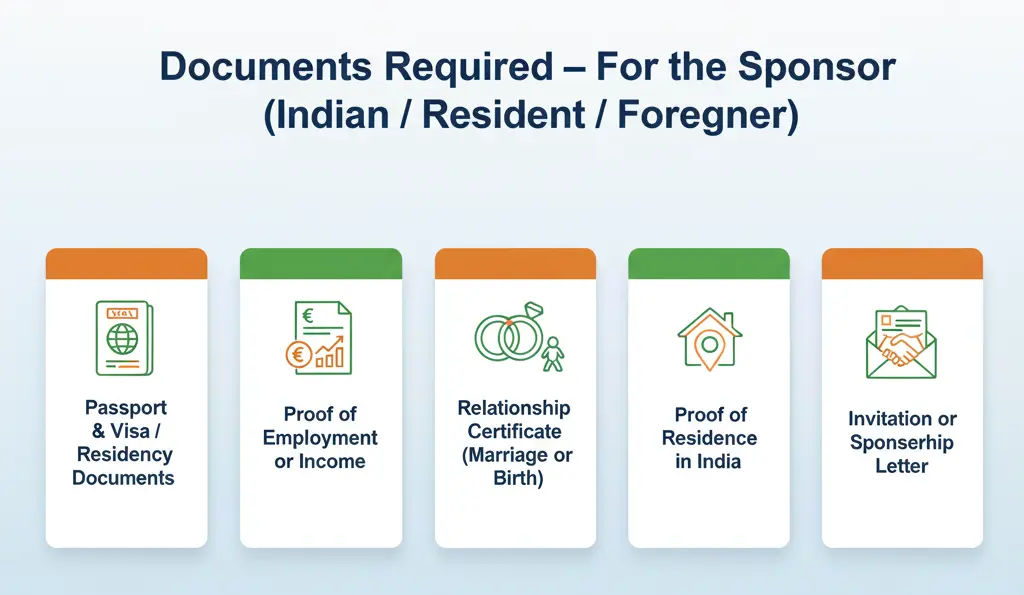
– Passport and visa/residency documentation
– Proof of employment or income
– Relationship certificate (marriage or birth certificate)
– Proof of residence in India
– Invitation or sponsorship letter
For the Applicant (Family Member):
– Valid passport (with a minimum validity of 6 months)
– Passport-sized photographs
– Marriage or birth certificate (translated if necessary)
– Medical and travel insurance
– Proof of accommodation (rental or hotel bookings)
– Copies of any prior visas (if applicable)
Rest assured, Quick Vakil manages document verification, translations, notarization, and attestation.
Step-by-Step Family Immigration Process with Quick Vakil
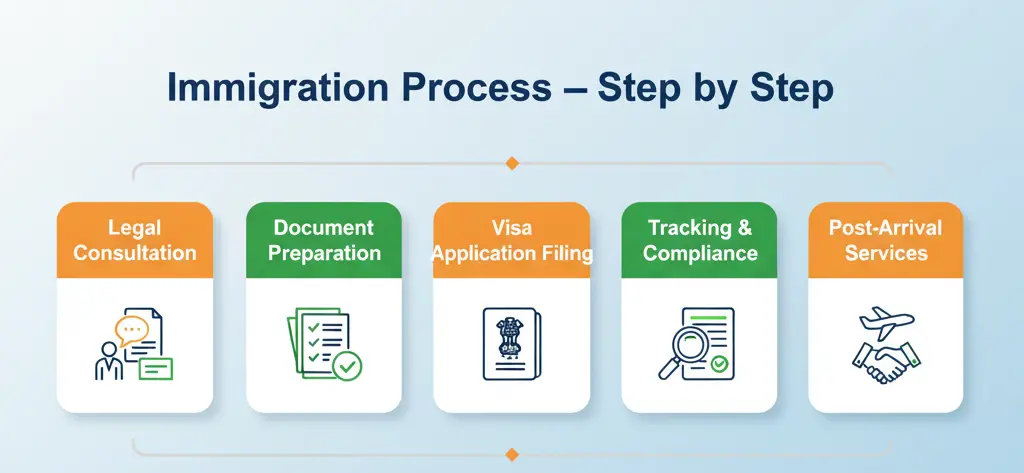
Step 1: Legal Consultation
We assess your family situation and immigration requirements.
Step 2: Document Preparation
Our specialists prepare and verify all documents in accordance with Indian immigration standards.
Step 3: Visa Application Filing
We submit your application to the FRRO, Indian consulates, or embassies, either online or offline.
Step 4: Tracking & Compliance
We monitor the visa status, attend appointments as necessary, and ensure complete compliance.
Step 5: Post-Arrival Services
This includes FRRO registration, visa extensions, OCI filing, and additional services.